Gum disease is the most common cause of tooth loss in adults — and most people who have it don't know. In its early stages it causes no pain. The warning signs are subtle: gums that bleed when you brush, slight redness, a little puffiness. Easy to ignore. That's exactly why it progresses silently until the damage is significant.
This guide covers everything — what gum disease is, how it develops, what the warning signs are, how it's treated at each stage, and why research consistently links it to serious health conditions throughout your body.
The most important thing to understand: Early gum disease (gingivitis) is completely reversible with professional cleaning and improved home care. Advanced gum disease (periodontitis) causes permanent bone loss that cannot be fully reversed — only stopped and managed. Catching it early is everything.
What gum disease actually is
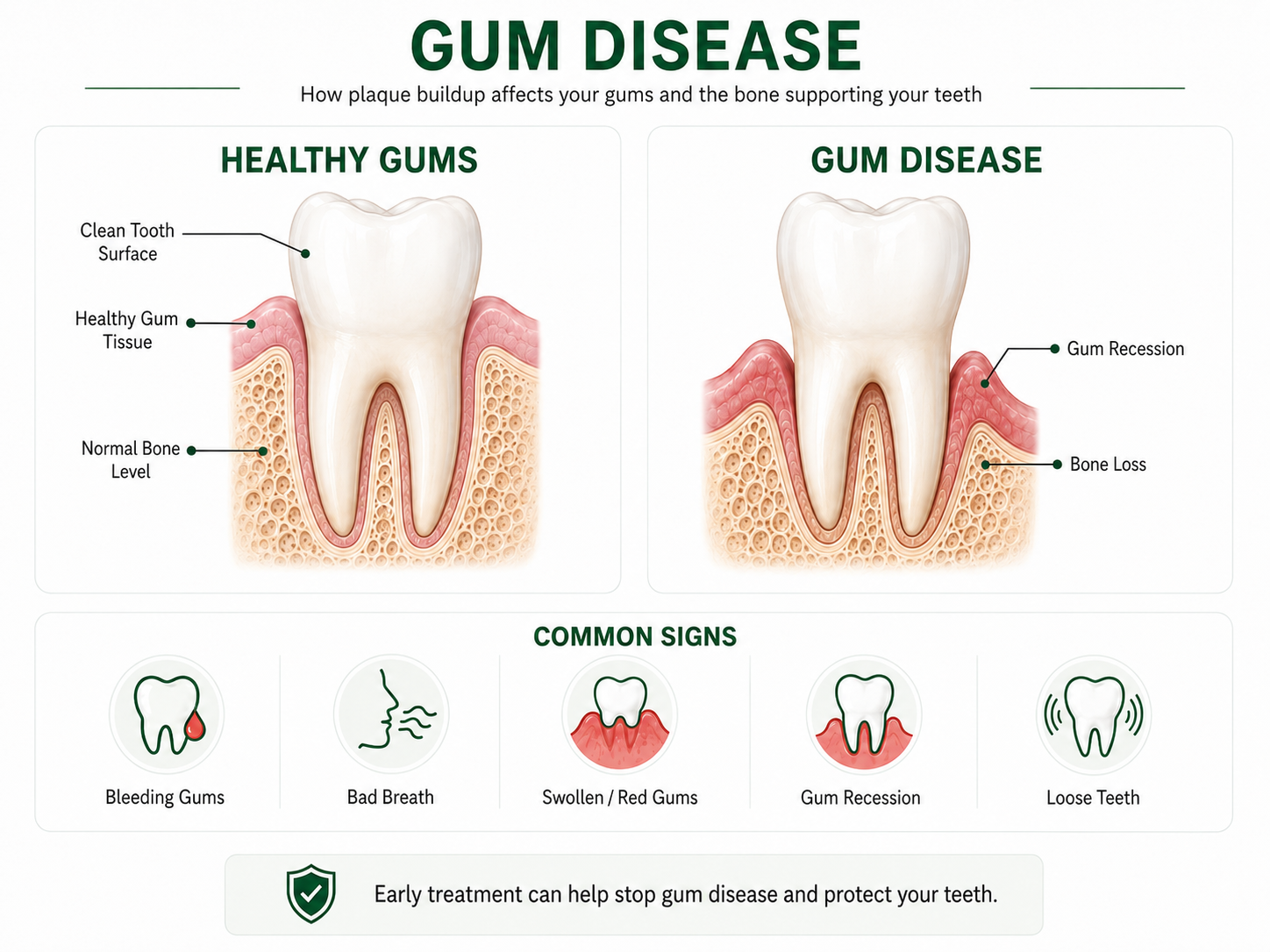
Gum disease — clinically called periodontal disease — is a bacterial infection of the structures that support your teeth: the gum tissue, the periodontal ligament, and the jawbone. It begins when bacterial plaque accumulates at and below the gumline and is not adequately removed.
The bacteria in plaque produce toxins that irritate the gum tissue, triggering an inflammatory response. Initially the inflammation is localized in the gum tissue. Over time, as the infection advances, the body's immune response and the bacteria together destroy the connective tissue and bone that hold teeth in place.
The biofilm problem — why gum disease is hard to stop
Bacteria in periodontal pockets don't exist as isolated cells — they organize into structured communities called biofilms. A biofilm is a colony of bacteria encased in a protective slime layer that makes them significantly harder to eliminate than free-floating bacteria. The bacteria multiply through three stages: attachment to the tooth surface, growth into an organized community, and dispersal to seed new infection sites throughout the mouth.
This is why brushing and flossing alone often can't resolve established gum disease — the biofilm below the gumline is inaccessible to home care tools. Professional debridement and scaling physically disrupts and removes these biofilm communities from root surfaces and periodontal pockets.
The stages of gum disease
Warning signs — what to watch for
Most people with early gum disease feel no pain. The signs are easy to miss or dismiss:
- Bleeding gums when brushing or flossing — the most common early sign. Healthy gums do not bleed. Any bleeding is a signal that inflammation is present.
- Red, swollen, or tender gum tissue — healthy gums are firm and pink. Puffiness and redness indicate inflammation.
- Persistent bad breath — the bacteria in periodontal pockets produce volatile sulfur compounds that cause chronic bad breath that doesn't resolve with brushing.
- Receding gums — teeth appearing longer as gum tissue pulls away from the tooth
- Loose or shifting teeth — a sign of significant bone loss supporting those teeth
- Pain when chewing — uncommon in early disease but present in more advanced stages
- Sensitive teeth — exposed roots from gum recession become sensitive to temperature
Bleeding gums are never normal
Many people believe their gums "just bleed" and accept it as part of their normal brushing experience. They don't. Healthy gum tissue does not bleed when you brush or floss correctly. Bleeding is always a sign of inflammation — which means bacteria are winning. It's not something to put up with; it's something to bring to your dentist.
Gum disease and your overall health — what the research shows
This is the part of gum disease most patients don't know about — and it's important. Research over the past two decades has established clear connections between periodontal disease and serious systemic health conditions. The mechanism is straightforward: the bacteria and inflammatory mediators from infected periodontal pockets enter the bloodstream and can affect organs and systems throughout the body.
Heart Disease
Periodontal bacteria have been found in arterial plaques. Gum disease is linked to increased risk of heart attack and stroke.
Diabetes
Gum disease worsens blood sugar control, and diabetes makes gum disease harder to manage. The relationship is bidirectional.
Alzheimer's Disease
Studies have found periodontal bacteria in the brains of Alzheimer's patients. Chronic oral inflammation may contribute to neuroinflammation.
Respiratory Disease
Inhaling oral bacteria can worsen COPD and pneumonia. Periodontal treatment has been shown to reduce respiratory complications in vulnerable patients.
Pregnancy Complications
Gum disease during pregnancy is linked to preterm birth and low birth weight babies. Treating gum disease reduces these risks.
Hardening of Arteries
Chronic oral inflammation contributes to arterial inflammation and atherosclerosis — hardening and narrowing of blood vessels.
Chronic Inflammatory Conditions
The persistent low-grade inflammation from untreated gum disease can trigger and worsen chronic inflammatory conditions throughout the body.
The mouth is the gateway to the body. Oral bacteria enter the body through infected gum tissue and small bleeding wounds in the periodontal pockets. From there they travel through the bloodstream and have been found in the heart, lungs, brain, and arteries. Treating gum disease is not just about saving teeth — it is about protecting your overall health.
Treatment — what each stage requires
Gingivitis — professional cleaning and home care
At the gingivitis stage, a professional cleaning that removes all tartar above and below the gumline, combined with improved brushing and flossing technique at home, is typically sufficient to resolve the inflammation completely. No permanent damage has occurred and the gum tissue returns to health.
Early to moderate periodontitis — scaling and root planing
Scaling and root planing — sometimes called a "deep cleaning" — is the primary treatment for periodontitis. The hygienist uses specialized instruments to remove tartar and bacterial deposits from the root surfaces below the gumline and smooth the root surface to remove bacterial toxins and help the gum tissue reattach. It is typically done in quadrants with local anesthesia for comfort. Most patients notice significant improvement in gum health within a few weeks.
Advanced periodontitis — surgical options
When pockets are too deep to clean effectively with scaling alone, surgical options may be needed. Osseous surgery reshapes the bone to reduce pocket depths. Gum grafts replace lost tissue. In severe cases, tooth extraction and bone grafting to prepare for implants may be the final pathway.
Maintenance — the most important step
Gum disease is a chronic condition — it can be controlled but not cured. After active treatment, maintenance appointments every 3 to 4 months (rather than the standard 6) are critical to keep bacterial levels below the threshold where damage progresses. Patients who skip maintenance appointments consistently see their gum disease return and worsen.
Assessing your risk factors
Some people are genetically predisposed to gum disease and should discuss ways to protect their health with their dentist or physician. But risk factors are not destiny — most are modifiable. Understanding yours helps you and your dentist make a proactive plan.
- Family history of gum disease — genetics plays a real role in susceptibility
- Tobacco use — smoking is the single biggest behavioral risk factor for gum disease and significantly impairs healing after treatment
- Diabetes — uncontrolled blood sugar dramatically worsens gum disease outcomes
- Poor nutrition — a diet lacking in nutrients weakens the immune response that fights gum infection
- Stress — chronic stress suppresses immune function and makes it harder to fight infection
- Certain medications — some blood pressure medications, antidepressants, and antihistamines reduce saliva flow, which protects the mouth
- Pregnancy — hormonal changes during pregnancy increase gum sensitivity and inflammation risk
For everyone, the best way to stop gum disease before it starts is to eat right, exercise, avoid tobacco, and maintain good oral hygiene. It is also important to take care of your overall oral health — not just your teeth but your gum tissue and the bone beneath it.
What you can do at home
- Brush twice daily with a soft-bristle brush, angling the bristles toward the gumline at a 45-degree angle
- Floss or use a water flosser daily — cleaning between teeth is not optional for gum disease management
- Use an antibacterial mouthwash — chlorhexidine rinses (prescription) or over-the-counter antibacterial rinses reduce bacterial load
- Don't smoke — smoking is the single biggest risk factor for gum disease and significantly impairs healing
- Manage blood sugar if diabetic — controlled blood sugar dramatically improves gum disease outcomes
The bottom line
Gum disease is silent, common, and consequential — not just for your teeth but for your heart, your brain, and your body. The good news is that caught early, it is completely reversible. Caught late, it requires more intensive treatment and ongoing management but can still be controlled.
If your gums bleed when you brush, if you have persistent bad breath, or if you haven't seen a dentist in over a year — make an appointment. What's happening in your mouth is connected to everything else.
Read the full article
Create a free SmileSmart account to unlock every article instantly.