Most patients have never heard of a coronectomy — but if your oral surgeon has mentioned it as an option for your wisdom tooth, it means your situation is specific and the decision matters. A coronectomy is an intentional partial removal of a tooth — specifically designed for cases where a full extraction carries significant nerve risk.
This guide explains exactly what a coronectomy is, why it exists, when it's the right choice, and what the procedure and recovery involve.
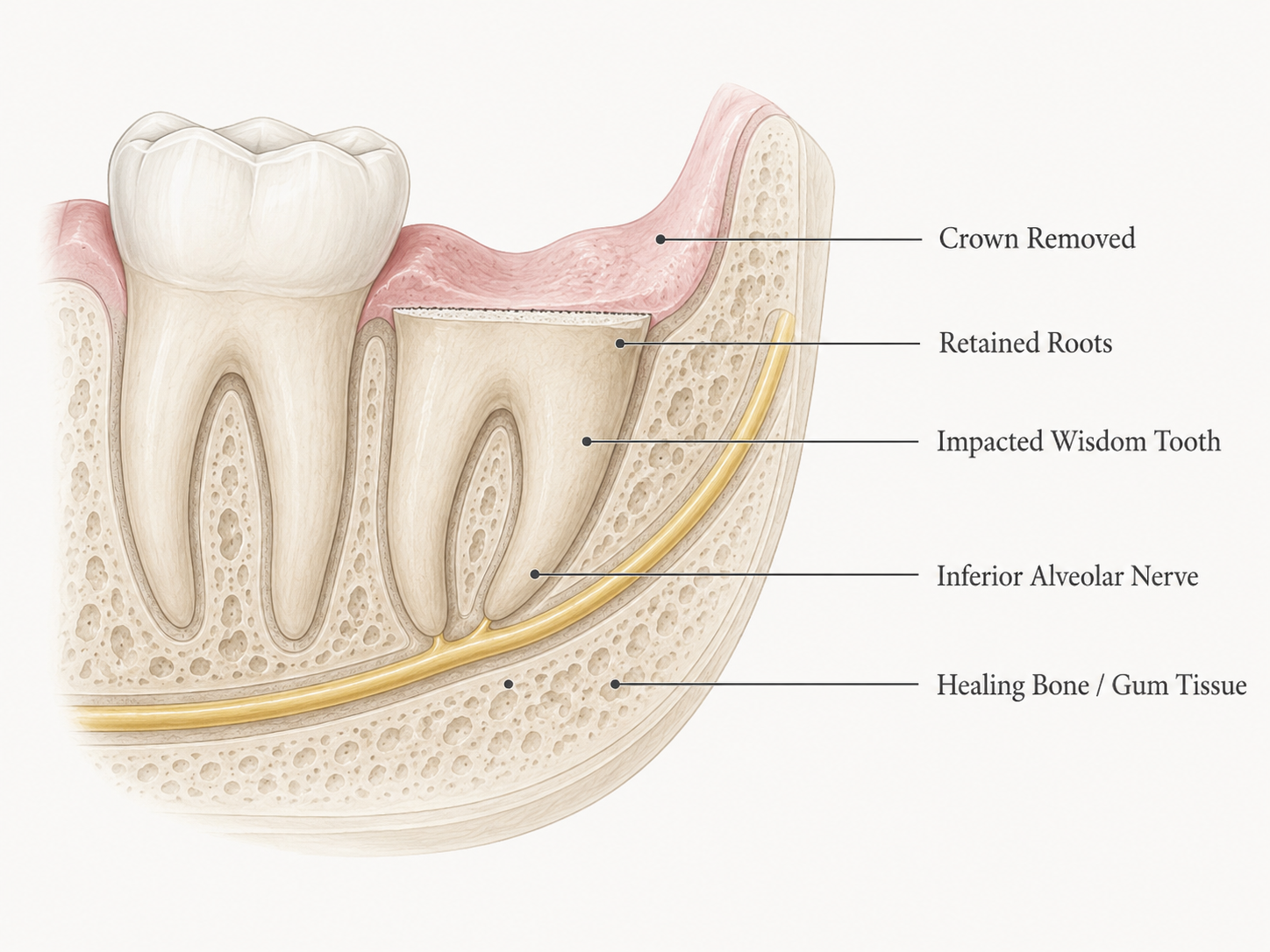
The simple explanation: In a coronectomy, the crown of the tooth (the visible portion) is surgically removed and the roots are deliberately left in place. The roots are left because they are sitting too close to or touching the inferior alveolar nerve — and moving them carries a high risk of permanent nerve damage.
Why a coronectomy is sometimes better than full extraction
The inferior alveolar nerve runs through the mandible (lower jaw) in a canal directly beneath the lower wisdom teeth. In most patients, there is adequate distance between the wisdom tooth roots and this nerve, and full extraction is straightforward.
In some patients — particularly those who delayed extraction until their late 20s or beyond — the roots have grown long and curved, and on dental imaging (panoramic X-ray or CBCT scan) they appear to be in direct contact with or wrapping around the nerve canal.
Attempting a full extraction in these cases carries a meaningful risk of inferior alveolar nerve injury, which can cause:
- Numbness of the lower lip, chin, or teeth on the affected side
- Tingling, burning, or altered sensation (paresthesia)
- In rare cases, permanent nerve damage
A coronectomy eliminates this risk by leaving the roots in place — away from the nerve — while removing the crown that was causing problems (pain, infection, decay).
Who is a candidate for a coronectomy
Coronectomy is not appropriate for every impacted wisdom tooth. It is specifically indicated when:
- CBCT or panoramic imaging shows high-risk nerve proximity
- The tooth has no active infection — coronectomy should not be done on infected teeth as it can trap infection
- The roots are not mobile
- The patient is healthy enough for the procedure
What happens during the procedure
- Anesthesia. Local anesthetic is administered. Sedation is available and commonly used.
- Incision. The gum tissue is reflected to expose the tooth and overlying bone.
- Crown removal. The crown of the tooth is sectioned and removed. The roots are left in the socket intentionally.
- Root preparation. The remaining roots are smoothed down to sit approximately 3mm below the bone level.
- Closure. The gum tissue is sutured closed over the roots.
What happens to the roots left behind
This is the question most patients ask — and it's a valid one. The retained roots typically undergo one of two outcomes:
- Migration away from the nerve — in approximately 30 to 70% of cases, the roots migrate upward away from the nerve canal over the following months to years. If this happens sufficiently, a second procedure to remove the roots becomes possible with lower risk than the original extraction would have carried.
- Stable incorporation — the roots remain in place, surrounded by bone, causing no symptoms. Most patients with retained roots have no issues and require only periodic X-ray monitoring.
Risks and considerations
- A small percentage of coronectomies (around 5%) require a second procedure if the roots migrate upward enough to become symptomatic or if infection occurs
- Long-term X-ray monitoring is needed to track root position
- Coronectomy is not appropriate if the tooth is infected at the time of surgery
The bottom line
A coronectomy is a deliberate, evidence-based surgical decision — not a shortcut or a compromise. When imaging shows genuine nerve risk from full extraction, coronectomy significantly reduces the chance of permanent nerve injury while still resolving the clinical problem the tooth was causing. If your oral surgeon recommends it, it means they have looked carefully at your imaging and concluded the risk of full extraction is higher than the risk of leaving the roots. It is the right choice for the right patient.
<Read the full article
Create a free SmileSmart account to unlock every article instantly.