A tooth extraction is the removal of a tooth from its socket in the jawbone. It sounds intimidating — and most people dread the idea — but extractions are one of the most common dental procedures performed, and with modern anesthesia, the experience is far less dramatic than the word implies.
This guide explains the different types of extractions, why they become necessary, what happens during the procedure, and how to care for the socket during healing.
Important context: Dentists always prefer to save a tooth when possible. An extraction is recommended only when the tooth cannot be saved through other means — or when keeping it would cause more harm than removing it.
Why extractions are needed
There are several situations where extraction becomes the best or only option:
- Severe decay or infection — when the tooth is too damaged for a filling or root canal to save it
- Advanced gum disease — when the supporting bone has deteriorated to the point where the tooth is loose and cannot be stabilized
- Impacted wisdom teeth — teeth that are stuck in the jaw or growing at an angle that damages neighboring teeth
- Crowding — orthodontic treatment sometimes requires removal of one or more teeth to create space
- Broken tooth — a fracture that extends below the gumline and cannot be restored
- Baby teeth that don't fall out — blocking permanent teeth from erupting properly
Simple vs surgical extraction
Simple Extraction
For a fully erupted tooth visible above the gumline. Loosened with an elevator and removed with forceps. Quick and straightforward.
Surgical Extraction
For impacted or broken teeth below the gumline. A small incision is made in the gum tissue. May require sectioning the tooth.
Wisdom Tooth Removal
Often a surgical extraction. Done by an oral surgeon for impacted cases. Sedation options are commonly available.
What happens during the procedure
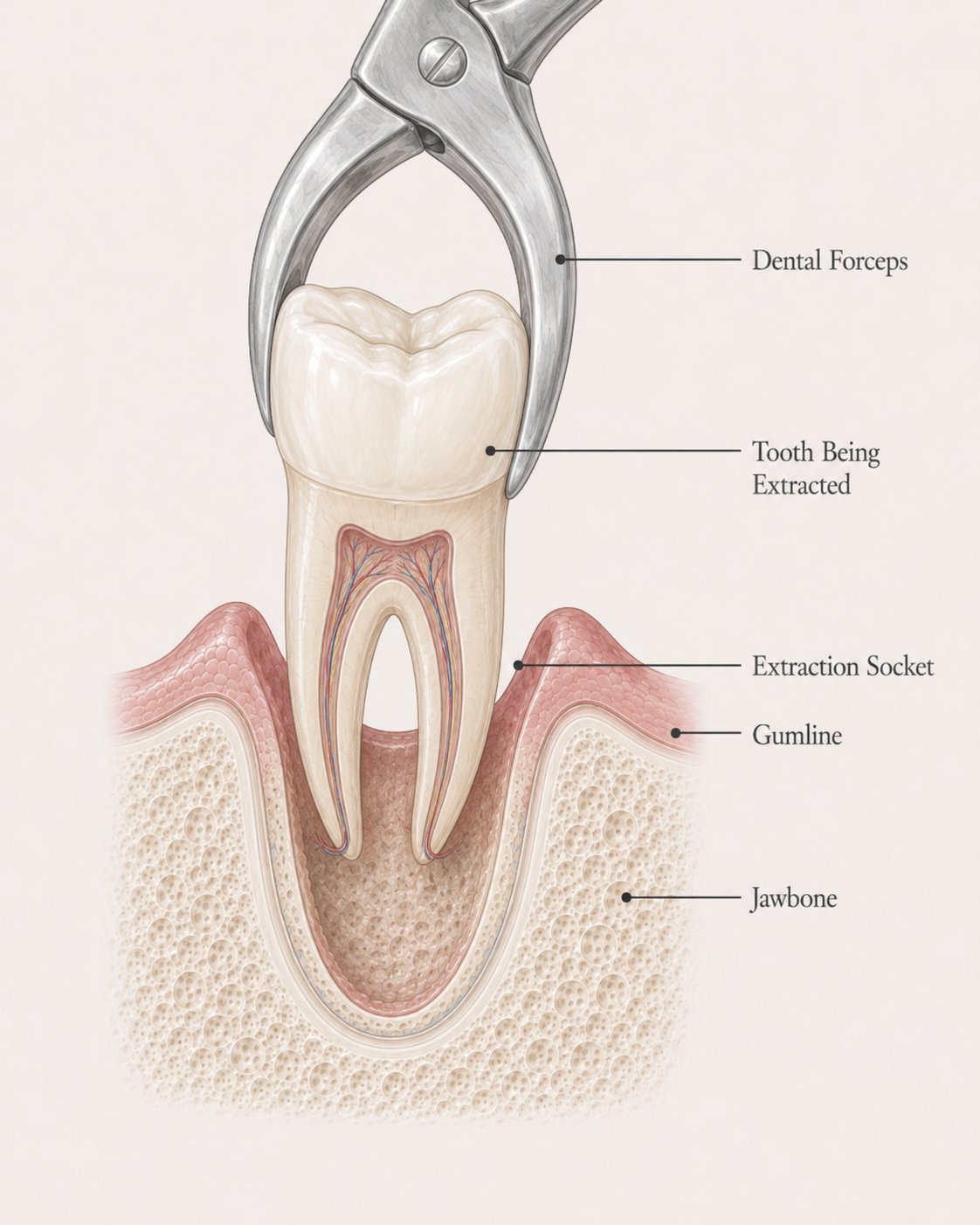
- Anesthesia. The area around the tooth is fully numbed with local anesthetic. For surgical extractions or anxious patients, sedation options are available. You should feel pressure and movement but not pain.
- Loosening the tooth. The dentist uses an elevator instrument to rock the tooth back and forth, expanding the socket and loosening the ligaments that hold the tooth in place.
- Removal. Once adequately loosened, the tooth is removed with extraction forceps. You will feel significant pressure — this is normal and expected.
- Socket care. Gauze is placed over the socket and you bite down firmly to control bleeding and begin clot formation. In some cases, dissolving sutures are placed.
Healing and aftercare
Proper aftercare is critical after an extraction. The goal is to protect the blood clot that forms in the socket — this clot is what allows the socket to heal.
- Bite on gauze for 30–45 minutes after the procedure to control bleeding
- Do not smoke, spit forcefully, or use a straw for at least 72 hours — suction dislodges the clot
- Eat soft foods — yogurt, eggs, mashed potatoes, smoothies — for the first 24–48 hours
- Avoid the extraction site when brushing for the first day
- Apply ice to the outside of your cheek in 20-minute intervals to reduce swelling
- Take prescribed pain medication as directed — ibuprofen helps with both pain and inflammation
Watch for dry socket
Dry socket occurs when the blood clot is dislodged or dissolves before healing is complete, exposing the bone. It causes significant, throbbing pain usually starting 2 to 4 days after extraction. If your pain is worsening rather than improving after day two, contact your dentist — dry socket is treatable but requires a dentist visit.
What comes next — replacing the tooth
If a permanent tooth was removed, your dentist will discuss replacement options — typically a dental implant, a bridge, or a partial denture. Leaving a gap unfilled can cause neighboring teeth to shift over time, affecting your bite and the alignment of remaining teeth.
The bottom line
Extractions are not something to fear. With proper anesthesia the procedure itself is manageable, and following aftercare instructions carefully makes recovery smooth. If your dentist recommends one, ask whether any alternatives exist — and if not, don't delay. An infected or impacted tooth won't improve on its own.
Read the full article
Create a free SmileSmart account to unlock every article instantly.