Dental veneers are thin shells of porcelain or composite resin bonded permanently to the front surface of teeth to change their color, shape, size, or length. They're one of the most popular cosmetic dental treatments and can dramatically transform a smile in as few as two appointments.
This guide explains what veneers can and can't fix, the difference between porcelain and composite options, the full procedure, and the honest trade-offs involved in choosing them.
Important distinction: Veneers are a cosmetic procedure — they change how teeth look, not how they function. They are not a treatment for decay, gum disease, or structural damage. Those issues need to be addressed before veneers are placed.
What veneers can fix
Discoloration
Teeth that are too dark or stained for whitening to fix — including tetracycline staining and intrinsic discoloration.
Chips & Fractures
Small chips on the front of teeth. Veneers cover the damaged area and restore the natural shape.
Shape & Size
Teeth that are too small, too short, uneven, or irregularly shaped can be lengthened and reshaped.
Minor Gaps
Small spaces between front teeth can be closed with veneers without orthodontic treatment.
Mild Misalignment
Slightly crooked or overlapping front teeth that don't warrant full orthodontic treatment.
Worn Enamel
Teeth worn down from acid erosion or grinding that have lost their shape and translucency.
Porcelain vs composite veneers
Porcelain Veneers
- Custom-fabricated in a dental lab
- Extremely natural-looking — mimics light reflection of real enamel
- Highly stain resistant
- Typically lasts 10 to 20 years
- Requires removal of a thin layer of enamel — irreversible
- Two to three appointments
- Cost: $1,000–$2,500 per tooth
Composite Veneers
- Applied directly to the tooth in the office — no lab required
- Less tooth removal needed — sometimes none
- Less expensive
- Can be repaired easily if chipped
- More prone to staining over time
- Typically lasts 5 to 8 years
- Cost: $250–$1,500 per tooth
The porcelain veneer procedure
- Consultation and planning. Your dentist assesses your teeth, discusses your goals, and determines whether veneers are appropriate. Photos and impressions may be taken to plan the final result.
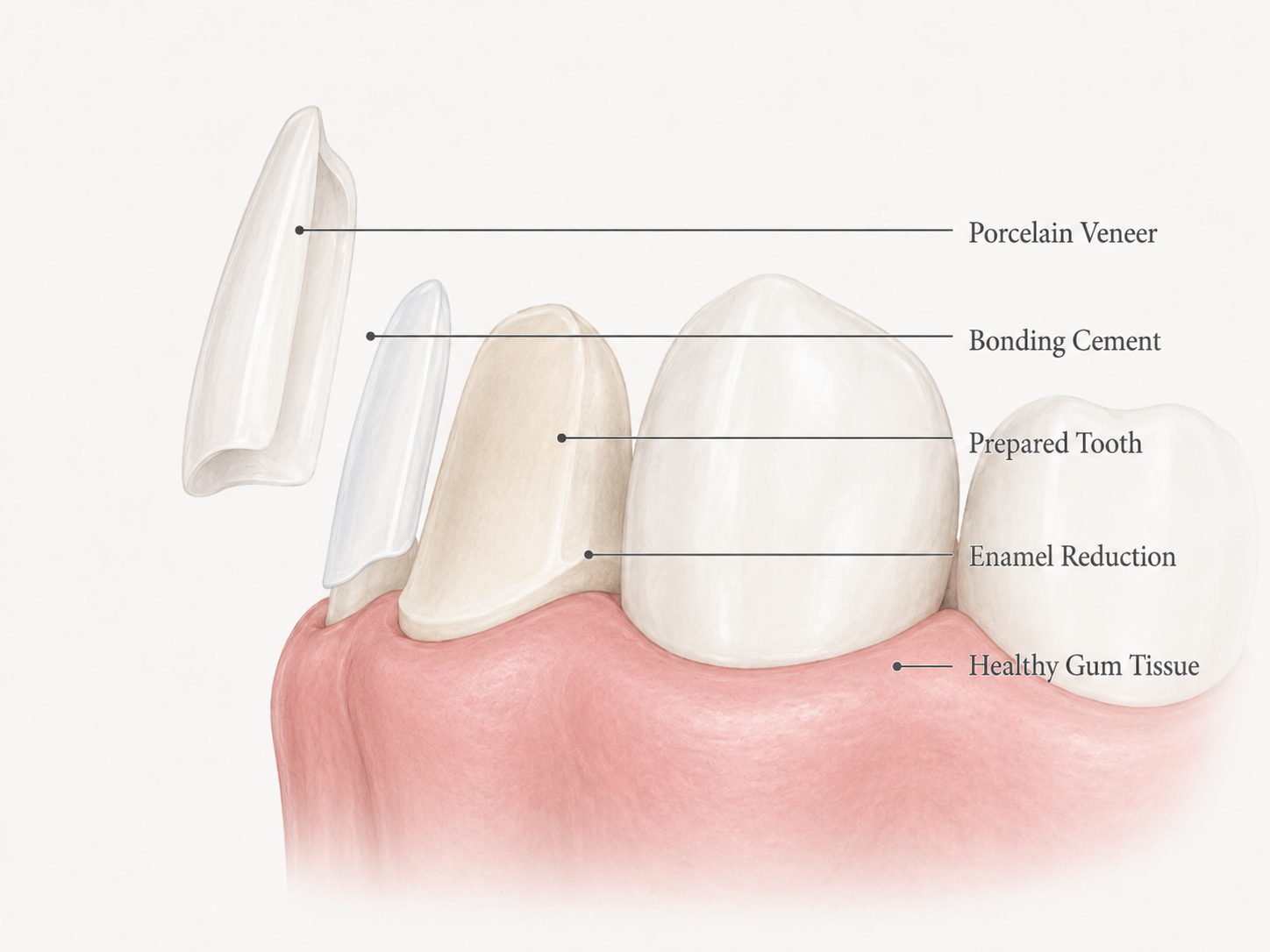
- Tooth preparation. A thin layer of enamel — typically 0.3 to 0.5mm — is removed from the front surface of each tooth receiving a veneer. This is irreversible and is why veneers are considered a permanent commitment. Local anesthesia is used for comfort.
- Impression and temporaries. An impression is taken and sent to the dental lab. Temporary veneers are placed while the permanent ones are being fabricated — typically 1 to 2 weeks.
- Bonding. The permanent veneers are checked for fit, shape, and color. Once approved, the teeth are cleaned and etched, and the veneers are permanently bonded with dental cement and cured with a light.
Who is not a good candidate for veneers
- Patients with active tooth decay or gum disease — these must be treated first
- Patients who grind their teeth heavily — grinding can fracture veneers; a night guard is essential if veneers are placed
- Teeth with very little enamel remaining — not enough surface for proper bonding
- Patients seeking a reversible option — enamel removal is permanent
- Very severely misaligned teeth — orthodontics would be more appropriate
Caring for veneers
- Brush twice daily with a non-abrasive toothpaste and soft-bristle brush
- Floss daily — the gumline at the edge of veneers needs regular cleaning
- Avoid biting nails, chewing ice, or opening packages with your teeth
- Wear a night guard if you grind — this is non-negotiable with veneers
- Minimize highly pigmented food and drink — though porcelain resists staining, the bonding cement at the edges can discolor
The bottom line
Veneers are one of the most transformative cosmetic procedures in dentistry — capable of completely changing a smile's appearance in just two appointments. The key trade-off is permanence: enamel removal is irreversible. Anyone considering veneers should approach the decision carefully, choose an experienced dentist, and ensure underlying dental health issues are resolved first. When done well on the right patient, veneers can last two decades and look completely natural.
<Read the full article
Create a free SmileSmart account to unlock every article instantly.