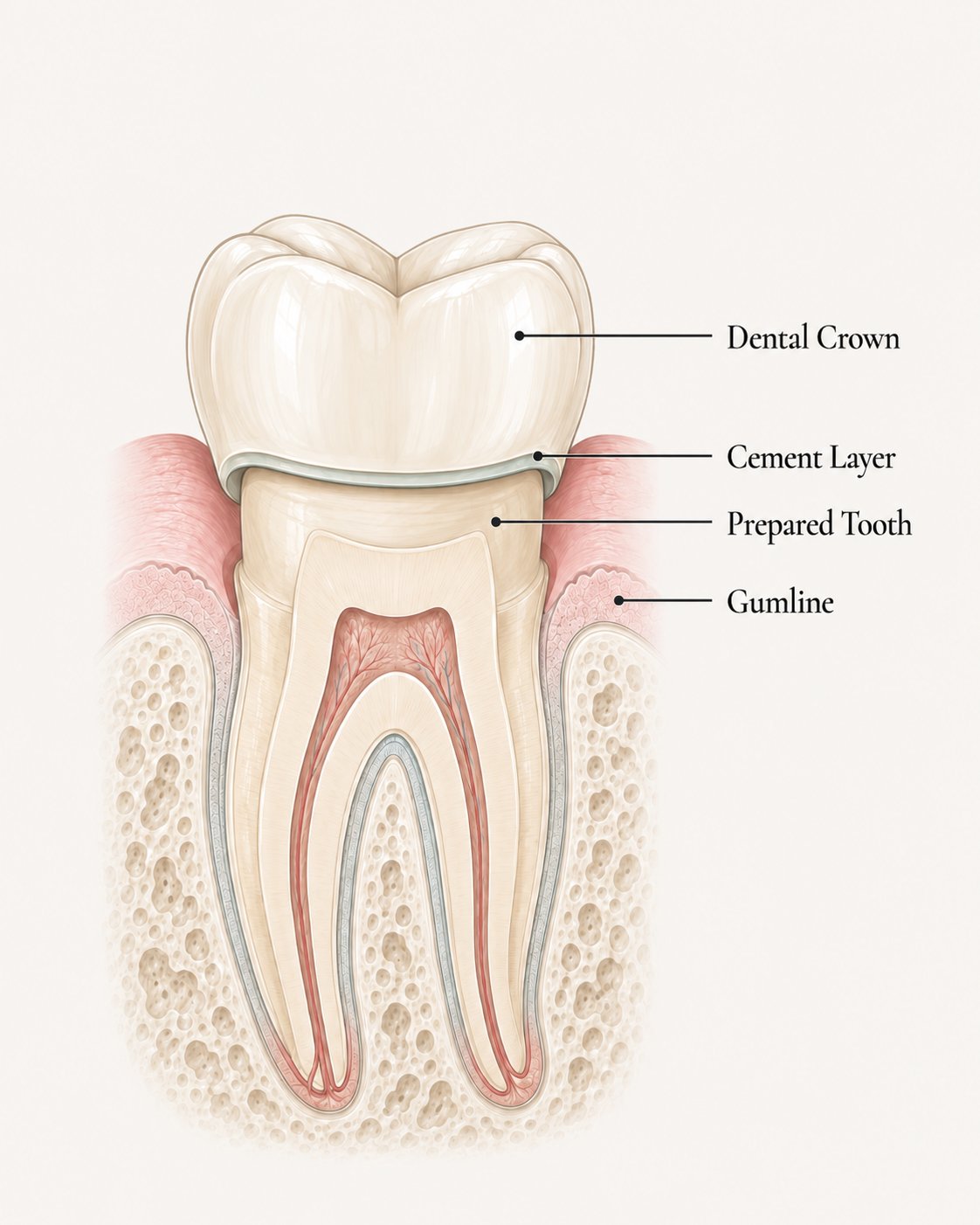
A dental crown is a cap that covers an entire tooth — from the gumline up. It looks and functions like a natural tooth and is one of the most versatile restorations in dentistry. Crowns are used to protect, restore, and strengthen teeth that can no longer be fixed with a simple filling.
If your dentist has recommended a crown, it means the tooth needs more protection than a filling can provide. This guide explains exactly why, what the procedure involves, what materials are used, and how to care for it afterward.
Think of a crown like a helmet for your tooth. It covers the entire visible portion and shields it from the forces of biting, chewing, and temperature — allowing a compromised tooth to function normally for years or decades.
Why a crown is needed
Crowns are recommended in several situations. The most common reasons your dentist may say you need one:
- After a root canal — the tooth becomes more brittle after the nerve is removed and needs a crown to prevent fracture
- A large cavity — when decay is too extensive for a filling to reliably restore the tooth
- A cracked tooth — a crown holds the tooth together and prevents the crack from deepening
- A severely worn tooth — from grinding or acid erosion
- A broken tooth — when a large piece of the tooth has fractured off
- To anchor a dental bridge — crowns are placed on the teeth on either side of a gap to hold a bridge in place
- To cover a dental implant — the crown is the visible portion of the implant restoration
Crown materials — what are they made of?
Porcelain / Ceramic
Most natural looking. Matches your tooth color exactly. Best for front teeth. Can chip under heavy force.
Porcelain-fused-to-metal
Strong metal core with porcelain exterior. Good aesthetics with more durability. A dark line may show at the gumline over time.
Gold / Metal Alloy
Extremely durable. Lasts the longest. Best for back teeth where strength matters most. Visible when you smile.
For front teeth, porcelain or ceramic is the standard choice because appearance is the priority. For back molars that endure heavy chewing forces, your dentist may recommend a metal or porcelain-fused-to-metal crown for greater durability.
The crown procedure — two appointments
A traditional crown takes two appointments about two weeks apart. Some offices have same-day crown technology (CEREC) that mills the crown in-house — one appointment instead of two.
Appointment 1 — Preparation
- Anesthesia. The tooth and surrounding area are numbed completely.
- Tooth reshaping. The dentist files down the outer surface of the tooth on all sides to create room for the crown to fit over it. The amount removed depends on the crown material.
- Impression. A mold or digital scan of the shaped tooth and surrounding teeth is taken and sent to a dental lab to fabricate your custom crown.
- Temporary crown. A temporary crown is placed over the prepared tooth to protect it while the permanent one is being made — usually 1 to 2 weeks.
Appointment 2 — Placement
- Temporary removal. The temporary crown is removed and the tooth is cleaned.
- Fit check. The permanent crown is placed and checked for fit, bite, and appearance before cementing.
- Cementation. Once everything checks out, the crown is permanently cemented onto the tooth.
How to care for your crown
- Brush twice daily and floss around the crown — pay attention to the gumline where the crown meets the tooth
- Avoid biting hard objects — ice, hard candy, pen caps, fingernails
- If you grind your teeth at night, ask your dentist about a night guard to protect the crown
- See your dentist regularly — they check the crown margins at every checkup
How long does a crown last?
With proper care, a crown typically lasts 10 to 15 years. Many last significantly longer — 20 to 30 years is not uncommon. The main reasons crowns fail are decay at the margin (the edge where the crown meets the tooth), fracture, or gum recession that exposes the underlying tooth.
The bottom line
A crown is one of the most reliable and long-lasting restorations in dentistry. When a tooth is too damaged for a filling but still has a healthy root, a crown is the treatment that saves it. Done correctly and cared for properly, a crown can function for decades.
Read the full article
Create a free SmileSmart account to unlock every article instantly.