If you're missing several teeth but not all of them, your dentist may recommend a removable partial denture instead of individual implants or a bridge. The two most common types — metal-framework partials and flexible Valplast partials — work very differently and suit different situations.
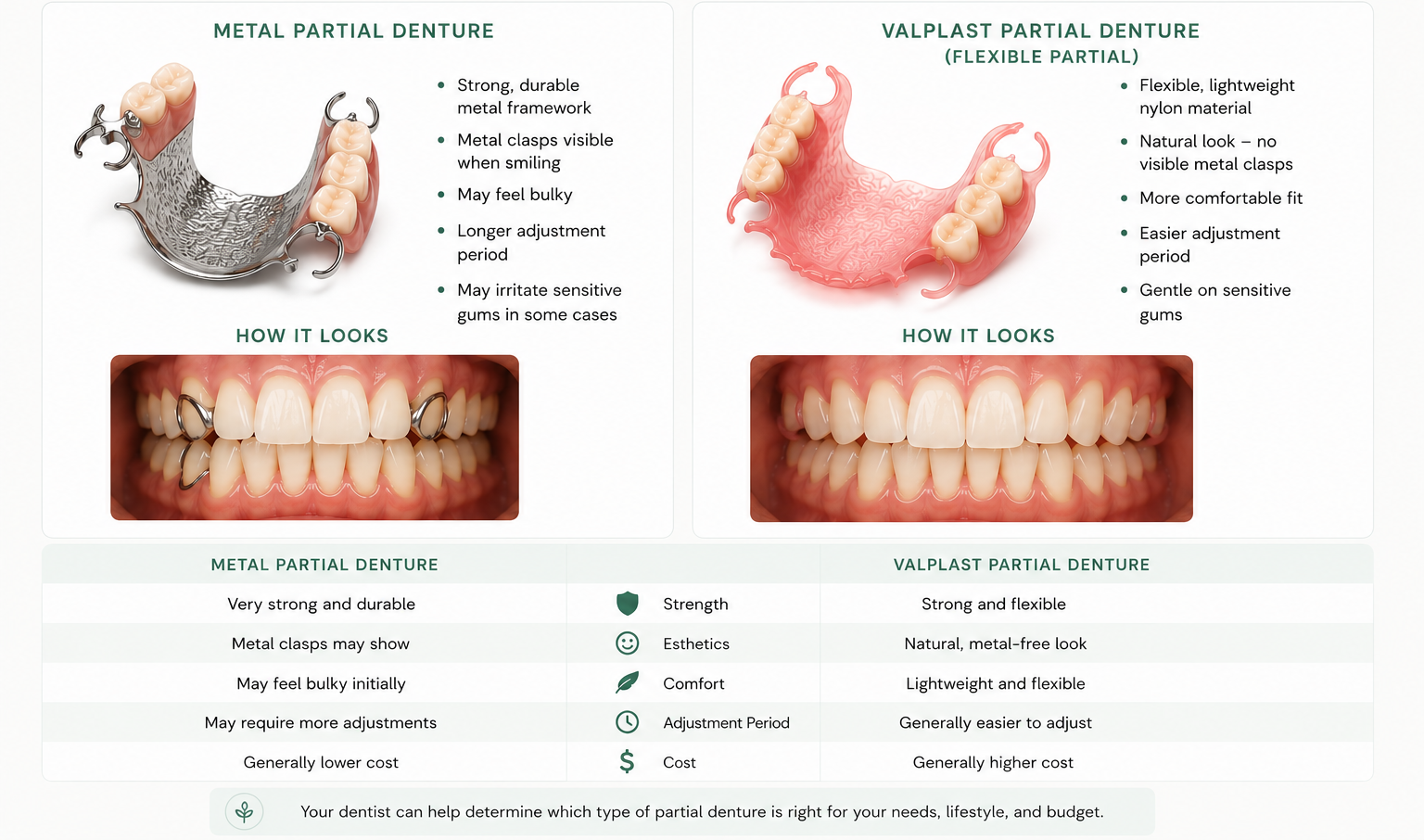
The core tradeoff: metal partials are more rigid and durable with a sturdier bite, while Valplast partials are more flexible, more comfortable to wear, and look more natural — but compromise slightly on long-term stability.
Metal-framework partials
A traditional partial denture has a rigid metal framework, usually cast from a cobalt-chromium alloy, with metal clasps that hook around remaining natural teeth for support. The framework distributes biting forces evenly and holds its shape reliably over years of use.
The tradeoff is visibility — the metal clasps can sometimes be seen when you smile or talk, especially if the partial replaces a front tooth. Some patients also describe an initial adjustment period getting used to the feel of metal against their gums and remaining teeth.
Valplast (flexible) partials
Valplast partials use a flexible nylon resin instead of metal. The material is thin, lightweight, and made in a translucent, gum-colored shade that blends in far more naturally — the clasps are nearly invisible against pink gum tissue.
Because the material flexes slightly, it's generally more comfortable to insert and remove, and many patients report a shorter adjustment period. The flexibility is also the main long-term limitation: over years of use, a flexible partial can lose some of its precise fit faster than a rigid metal framework, sometimes requiring more frequent relines or replacement.
Side-by-side comparison
Metal Partial
- More rigid, stable bite
- Long-term durability
- Metal clasps may show
- Generally lower cost
- Can be added to/repaired more easily
Valplast Partial
- More natural, less visible
- More flexible and comfortable
- Lighter weight
- May need more frequent relines
- Generally higher cost
Who tends to be a better fit for each
Metal partials are often recommended when there are more missing teeth to support, when a patient needs maximum bite stability, or when cost is a significant factor. Valplast tends to be recommended for smaller, more visible gaps — especially toward the front of the mouth — where appearance matters most and the bite forces involved are lower.
Some patients also simply can't tolerate metal against their gums due to allergy or sensitivity, which makes Valplast the more comfortable long-term option regardless of other factors.
Caring for either type
Both types should be removed and cleaned daily with a denture-specific cleaner — regular toothpaste can be too abrasive, especially for Valplast's resin surface. Both should be stored in water or a denture-soaking solution when not worn, since drying out can affect material stability over time, particularly for Valplast.
The bottom line
Neither option is universally "better" — metal partials win on durability and bite stability, Valplast wins on appearance and comfort. Your dentist's recommendation usually comes down to how many teeth need replacing, where they are in your mouth, and how much each factor matters to you personally.
Read the full article
Create a free SmileSmart account to unlock every article instantly.