Dentures are removable prosthetic devices that replace missing teeth and the surrounding gum tissue. They've been used for centuries, but modern dentures are far more natural-looking, better fitting, and more comfortable than anything that existed even a decade ago. If you're facing tooth loss — or already dealing with it — this guide explains every option clearly.
Two main types: A complete (full) denture replaces all teeth on either the upper or lower arch. A partial denture replaces some missing teeth when healthy natural teeth remain. Both are custom-made to fit your mouth.
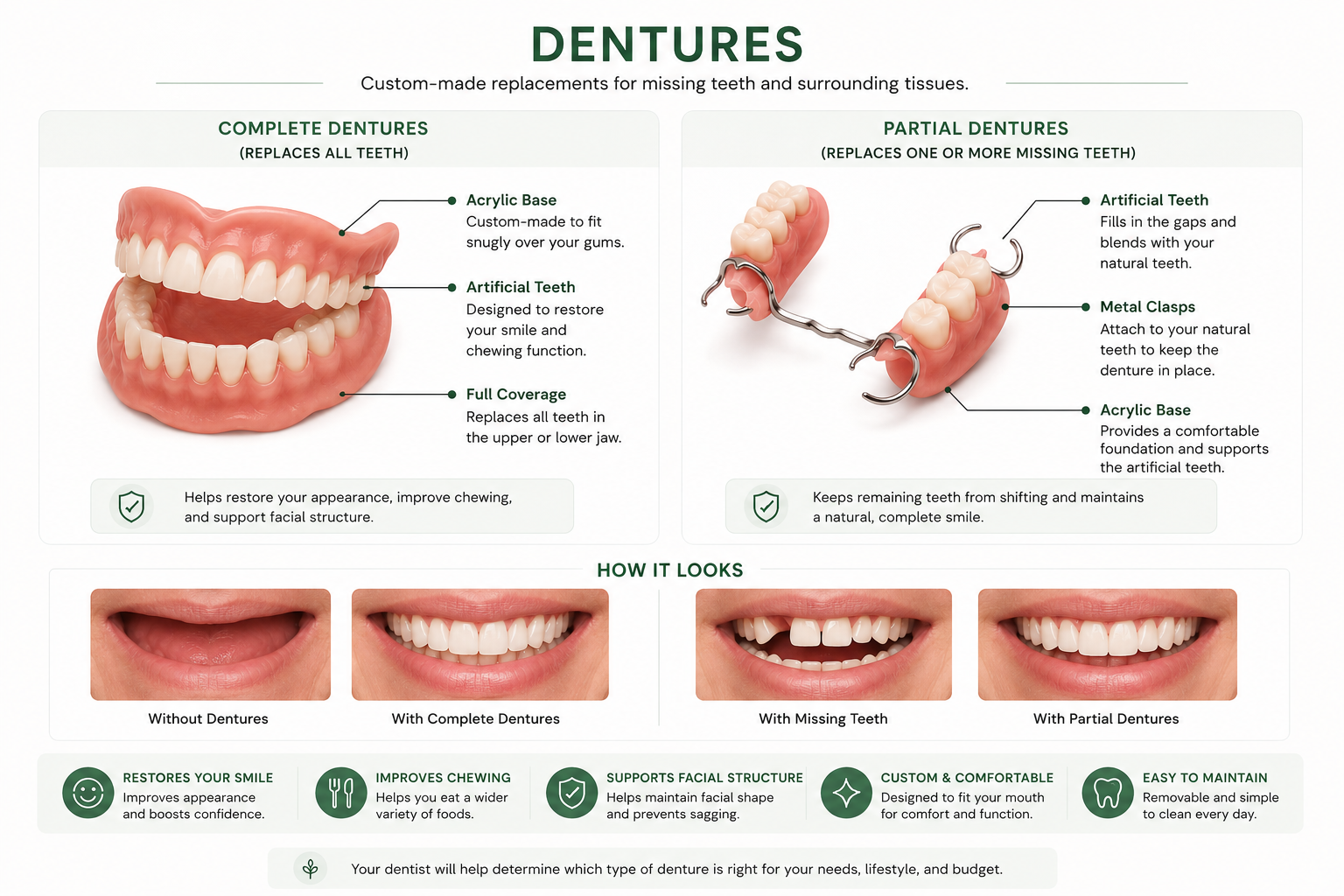
Complete (full) dentures
A complete denture is placed after all teeth in an arch have been removed and the gum tissue has healed. It rests directly on the gum tissue and is held in place by suction, the natural contours of the mouth, and in some cases denture adhesive.
Conventional vs immediate dentures
Conventional Denture
- Placed after extraction sites have fully healed — typically 8 to 12 weeks after removal
- Better fit because the gums have finished shrinking
- Patient is without teeth during the healing period
- More accurate final fit and appearance
Immediate Denture
- Made in advance and placed the same day teeth are extracted
- Patient is never without teeth
- Requires relining or replacement as gums shrink during healing
- Fit will change significantly in the first few months
Partial dentures
A partial denture is used when one or more natural teeth remain in the upper or lower jaw. It fills the spaces created by missing teeth and prevents remaining teeth from shifting into the gaps.
Partial dentures consist of replacement teeth attached to a gum-colored plastic base, sometimes connected by a metal framework that clasps onto existing natural teeth for stability. They are removed for cleaning and while sleeping.
When a partial denture is recommended over a bridge or implant
- Multiple teeth are missing in different locations across the arch
- The remaining teeth are not strong enough to support a fixed bridge
- Budget constraints make implants impractical at the time
- The patient prefers a non-surgical removable option
Implant-supported dentures
Implant-supported dentures — sometimes called snap-on or overdentures — are anchored by two to four dental implants placed in the jawbone. Unlike conventional dentures that rest on the gums, these snap onto the implants for a significantly more secure fit. They can still be removed for cleaning but don't move or shift during eating and speaking.
They are the best functional option for patients who need full arch replacement but want something more stable than a conventional denture. The implants also preserve jawbone, which conventional dentures cannot do.
The process of getting dentures
- Initial consultation and impressions. Your dentist takes impressions of your jaw and measures how your jaws relate to one another.
- Models and try-in. A wax model of the denture is created and tried in your mouth so shape, color, and fit can be assessed and adjusted before the final version is made.
- Final denture placement. The finished denture is placed, adjusted for fit and bite, and any necessary modifications are made.
- Follow-up appointments. Multiple follow-up appointments are typically needed in the first weeks to address sore spots and refine the fit.
The adjustment period
New dentures almost always require an adjustment period. Soreness, increased saliva production, and difficulty speaking or chewing in the first few weeks are completely normal. Your mouth and facial muscles need time to adapt to the new appliance.
- Start with soft foods cut into small pieces during the first few weeks
- Practice speaking out loud — reading aloud to yourself helps speed up adaptation
- Return to your dentist for adjustments whenever sore spots develop — don't try to adjust the denture yourself
- Expect fit to change over time as the jawbone underneath gradually resorbs
Caring for your dentures
- Remove and rinse after eating — run water over them to remove food debris
- Clean daily with a soft denture brush and denture cleaner — not regular toothpaste, which is too abrasive
- Soak overnight in water or a denture soaking solution — most dentures need to remain moist to keep their shape
- Clean your gums, tongue, and palate every morning before inserting dentures
- Handle carefully — drop them over a folded towel or sink of water; dentures break easily if dropped on a hard surface
- See your dentist regularly — even with no natural teeth, annual exams check for oral cancer and assess fit
Relining and replacement
As the jawbone beneath a denture changes shape over time — which it inevitably does — the denture fit will deteriorate. A loose-fitting denture causes sore spots, difficulty chewing, and accelerates further bone loss. Dentures typically need relining every 1 to 2 years and replacement every 5 to 10 years.
The bottom line
Modern dentures are a legitimate, functional solution for tooth loss. For patients who need full arch replacement and want the most stable result, implant-supported dentures are the best available option. For patients who need a more affordable or immediate solution, conventional full or partial dentures restore function and appearance effectively — with proper care and regular dental follow-up.
<Read the full article
Create a free SmileSmart account to unlock every article instantly.