If you're missing all or most of your teeth, you have more options today than the traditional full denture your grandparents might have worn. Implant-supported dentures — available as either permanently fixed or removable "clip-on" versions — solve some of the most common complaints about regular dentures, at a higher cost.
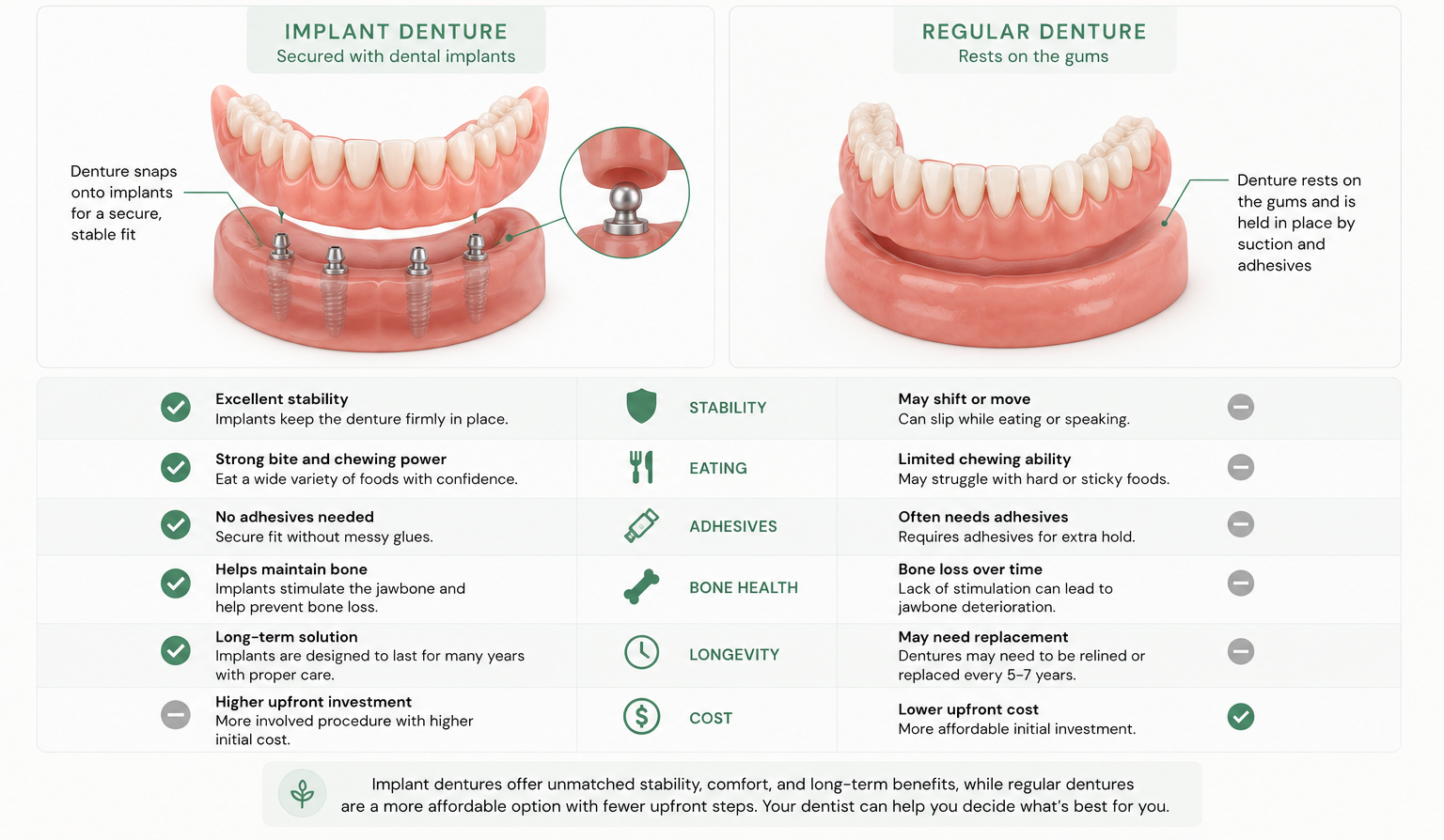
The core difference: a regular denture rests on your gums and is held by suction and adhesive; an implant denture anchors to titanium posts placed in the jawbone, giving it dramatically more stability.
Regular (conventional) dentures
A conventional full denture is custom-molded to rest directly on the gum ridge, held in place by suction, the shape of the ridge itself, and often denture adhesive. It's the least invasive and least expensive option, requiring no surgery.
The tradeoff is stability. Because there's nothing physically anchoring it, a regular denture can shift while eating or speaking, and most patients need to relearn how to chew certain foods. Over time, the jawbone beneath a denture naturally resorbs (shrinks) without the stimulation that natural tooth roots used to provide, which means the denture's fit changes and needs periodic adjustment or relining.
Implant-supported denture — permanent (fixed)
A fixed implant denture is secured permanently to several implant posts and isn't removed by the patient — only by a dentist, if ever needed. This option provides the closest experience to natural teeth: strong bite force, no slipping, and because the implants stimulate the jawbone the way natural roots did, bone loss is significantly slowed compared to a regular denture.
This is the most expensive and most invasive option, requiring multiple implant placement surgeries and a longer overall treatment timeline.
Implant-supported denture — removable (clip-on / overdenture)
A middle-ground option: the denture clips onto a smaller number of implants (often just 2 to 4) via attachments, but the patient can still remove it themselves for cleaning, the way they would a regular denture. This offers much better stability and confidence than a regular denture, at a lower cost and shorter treatment time than a fully fixed implant denture, since fewer implants are needed.
Side-by-side comparison
Regular Denture
- No surgery required
- Lowest cost
- Least stable, can shift
- Faster bone loss over time
- Needs adhesive for most patients
Implant-Supported (either type)
- Requires implant surgery
- Higher cost, longer timeline
- Significantly more stable
- Slows jawbone loss
- No adhesive needed
What actually drives the decision
Budget and the number of implants a patient's jawbone can support (sometimes limited by existing bone loss) are usually the biggest deciding factors. Patients who've already worn a regular denture for years and struggled with slipping or chewing difficulty are often the strongest candidates to consider upgrading to an implant-supported option, fixed or removable.
The bottom line
A regular denture is the most accessible option but the least stable; implant-supported dentures cost more and require surgery, but solve the slipping and bone-loss problems that frustrate most long-term denture wearers. The removable clip-on version is often the practical middle ground between cost and stability.
Read the full article
Create a free SmileSmart account to unlock every article instantly.