When your dentist recommends a crown, you'll often be offered a choice between materials. Two of the most common are PFM (porcelain-fused-to-metal) and zirconia — and the right choice depends on where the crown is going and what matters most to you.
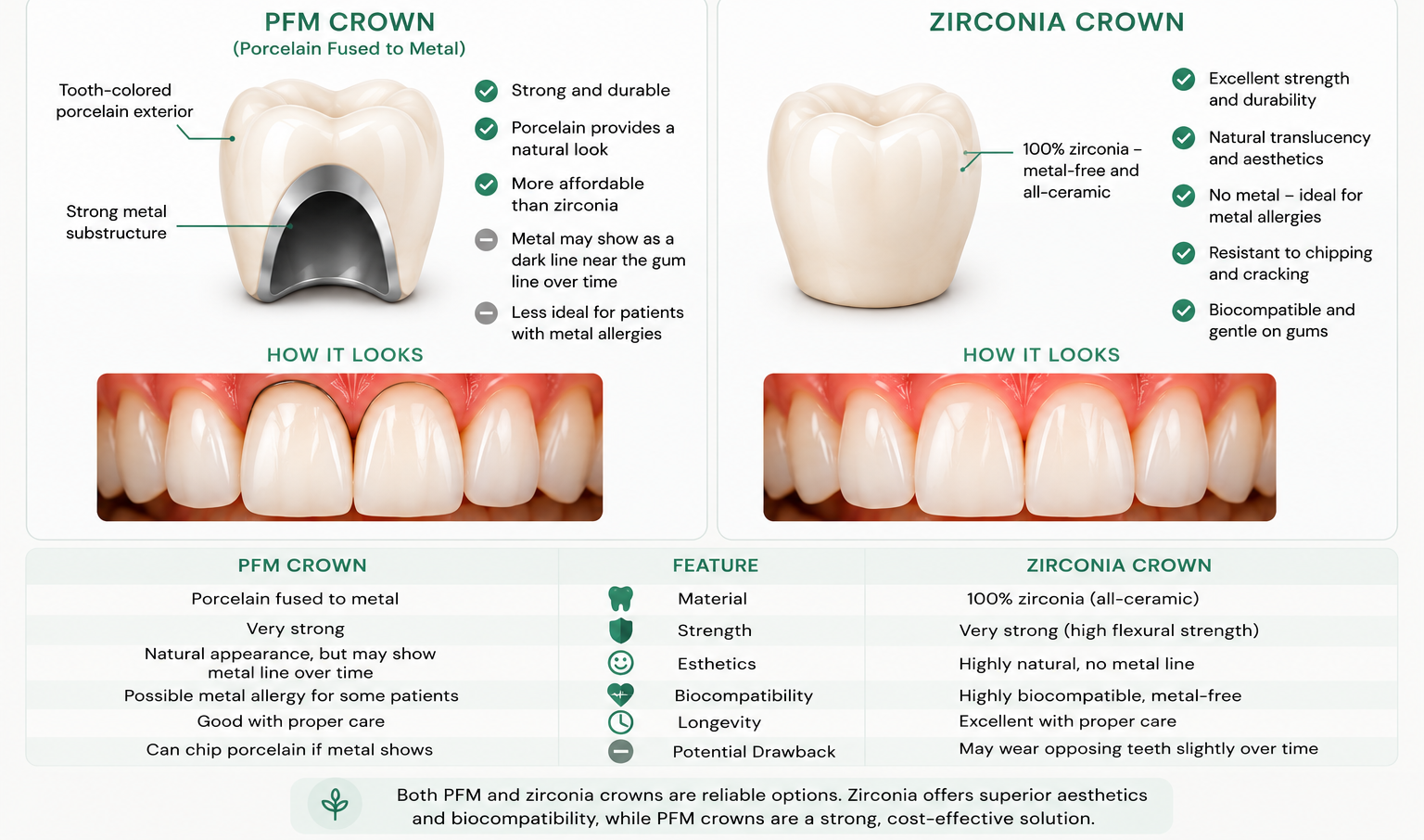
The core tradeoff: PFM crowns have decades of proven track record and excellent strength, but can show a dark line at the gumline over time; zirconia crowns look more naturally translucent and have no metal at all, but are a newer material with a shorter long-term track record.
PFM (porcelain-fused-to-metal) crowns
A PFM crown has an inner metal substructure (usually a gold or base-metal alloy) with porcelain fused over the outside to match your tooth color. This combination has been used reliably for decades — the metal core provides excellent strength, particularly useful for back teeth that handle heavy chewing forces.
The main cosmetic downside: over time, as gums naturally recede slightly with age, a thin dark line can become visible at the gumline where the metal substructure shows through. This is rarely an issue for back teeth but can matter more for a crown on a visible front tooth.
Zirconia crowns
Zirconia is a solid ceramic material with no metal component at all. It's extremely strong — strong enough to be used on molars — while also being more translucent and natural-looking than older all-ceramic materials, since there's no metal to block light transmission or create a dark line at the gum.
Zirconia has a shorter clinical track record than PFM simply because it's a newer material in widespread use, though the data so far suggests strong durability. Some patients report it feeling slightly different against opposing teeth compared to porcelain, though this varies by the specific zirconia formulation used.
Side-by-side comparison
PFM Crown
- Decades of proven durability
- Excellent strength
- Possible dark line at gumline over time
- Slightly less natural translucency
- Generally lower cost
Zirconia Crown
- No metal, no dark line
- Very strong, good for molars
- More natural light translucency
- Newer material, shorter track record
- Generally higher cost
Where each tends to be recommended
For back molars handling heavy bite force, both materials hold up well, and the choice often comes down to cost and personal preference rather than a clear clinical winner. For front teeth where appearance matters most, zirconia (or other all-ceramic options) is increasingly preferred specifically to avoid any visible metal or dark gumline over time.
Patients who grind their teeth heavily (bruxism) are sometimes better candidates for one material over the other depending on the specific case — this is a conversation worth having directly with your dentist, since it depends on the opposing teeth and bite pattern too.
The bottom line
Both materials are strong, reliable choices — PFM has the longer track record and slightly lower cost, while zirconia offers a more natural look with zero risk of a visible metal line. For visible front teeth, zirconia is increasingly the more popular choice; for back molars, either holds up well.
Read the full article
Create a free SmileSmart account to unlock every article instantly.