A dental bone graft is a procedure that rebuilds bone in the jaw where it has been lost or is insufficient. It sounds complex — and the name alone makes many patients anxious — but it is a well-established and commonly performed procedure that makes other treatments like implants possible.
If your dentist or oral surgeon has mentioned a bone graft, it almost certainly means they're preparing the foundation for a dental implant, or addressing bone loss caused by gum disease or an extraction. This guide explains exactly what a bone graft is, why it's needed, and what the procedure and recovery involve.
The simple explanation: Just as a builder needs a solid foundation before construction, a dental implant needs sufficient bone to be placed securely. When bone is missing, a graft rebuilds it — creating the structural foundation the implant needs to succeed.
Why bone loss happens
Jawbone needs stimulation to maintain its density and volume — that stimulation normally comes from the pressure transmitted through tooth roots during chewing. When a tooth is lost, the bone in that area no longer receives stimulation and begins to shrink — a process called resorption.
Bone loss can also occur from:
- Advanced gum disease (periodontitis) — bacterial infection destroys the bone supporting teeth
- Trauma — jaw injuries that damage or destroy bone
- Developmental defects — some people have naturally thin bone in certain areas
- Tooth loss without replacement — bone shrinks continuously when not stimulated
Types of bone graft material
Several materials can be used to rebuild bone, and your surgeon will choose based on your specific situation:
- Autograft — bone taken from your own body (chin, jaw, hip). Considered the gold standard because it contains living cells that stimulate new bone growth.
- Allograft — processed bone from a human donor bank. The most commonly used type. Safe, well-studied, and avoids a second surgical site.
- Xenograft — processed bone from an animal source (usually bovine). Provides a scaffold for new bone to grow into.
- Synthetic grafts — man-made materials that mimic bone structure and encourage new bone formation.
What is the membrane?
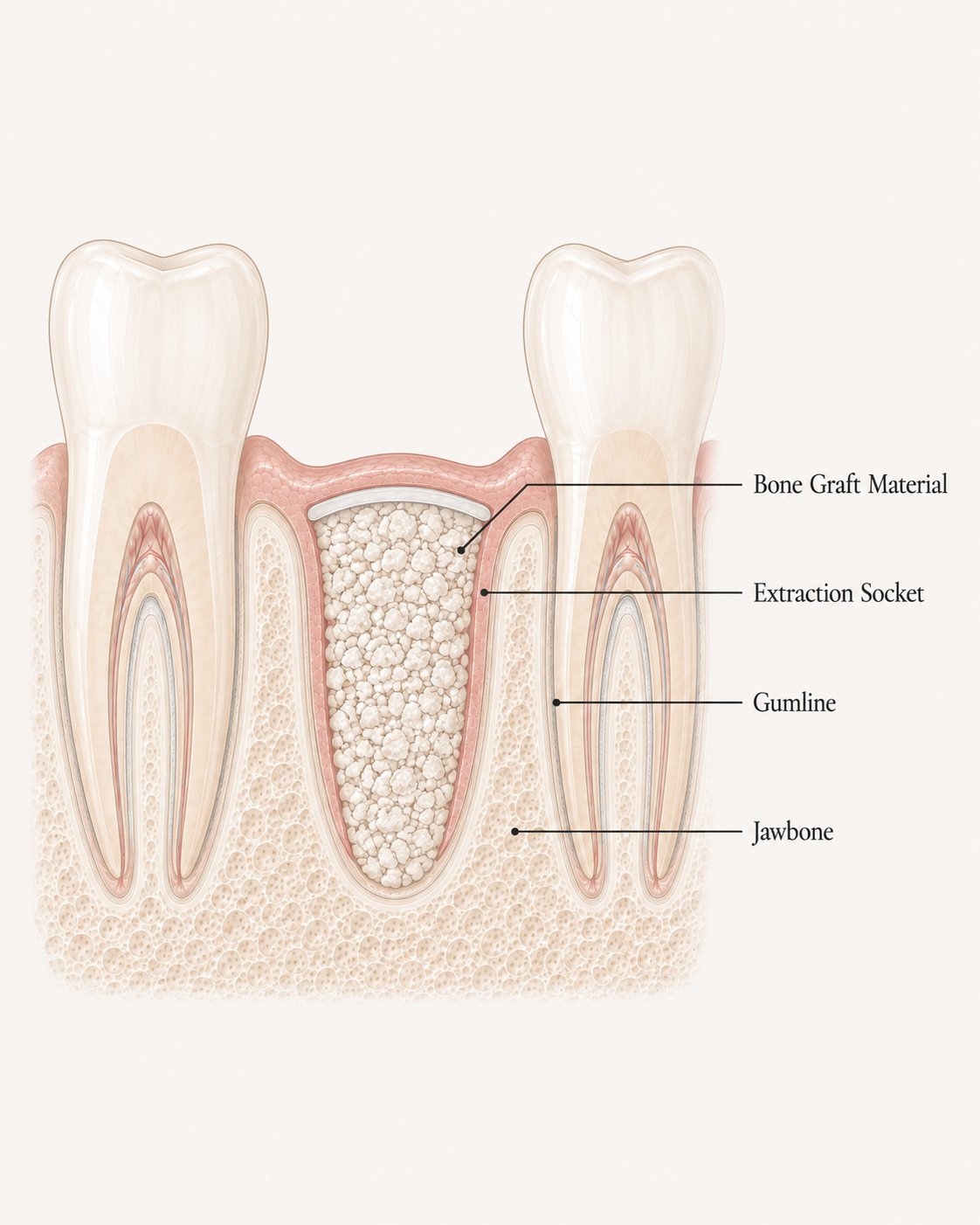
A membrane is often placed over the bone graft material as part of the procedure. It serves as a barrier that keeps soft tissue cells from growing into the graft site — which would interfere with bone regeneration. The membrane holds space and protects the graft while bone grows to fill the area. Some membranes are dissolving (absorbable) and don't need to be removed; others are non-dissolving and require a second procedure to remove.
What the procedure involves
- Anesthesia. The area is numbed with local anesthetic. Sedation is available if needed.
- Incision. A small incision is made in the gum tissue to expose the bone underneath.
- Graft placement. The graft material is placed in the deficient area and shaped to the desired contour.
- Membrane placement. A membrane is placed over the graft to protect it and contain it in position.
- Closure. The gum tissue is sutured closed over the graft site.
Healing timeline
Bone grafts take significantly longer to heal than soft tissue procedures — new bone formation is a slow biological process.
- First 2 weeks: Soft tissue heals. Some swelling and discomfort are normal. Take any prescribed antibiotics as directed.
- 3–6 months: New bone gradually fills the graft site. Avoid pressure on the area.
- After healing: Your dentist or surgeon will take X-rays to evaluate bone volume before proceeding with implant placement.
The bottom line
A bone graft is not something to be afraid of — it is a preparation step that makes future treatment possible. Without adequate bone, a dental implant cannot be placed securely. A graft rebuilds what was lost and gives the implant the foundation it needs to last a lifetime.
Read the full article
Create a free SmileSmart account to unlock every article instantly.