A dental implant is the closest thing dentistry has to a natural tooth replacement. It's a titanium post surgically placed into the jawbone that fuses with the bone over time — acting as an artificial tooth root. A crown is then attached to the top, creating a restoration that looks, feels, and functions like a real tooth.
Implants are considered the gold standard for replacing missing teeth because they're the only option that replaces the root as well as the visible tooth. This guide explains how they work, who's a candidate, what the full process involves, and what you can expect.
The key difference from other restorations: A bridge sits on top of adjacent teeth. A denture sits on the gum. An implant is anchored in the bone itself — which is why it feels and functions the most like a natural tooth and why it preserves jawbone.
The three parts of an implant
The Implant Post
A titanium screw placed in the jawbone. Acts as the artificial tooth root. Fuses with bone over 3–6 months.
The Abutment
A connector piece attached to the top of the implant post. Provides the connection point for the crown.
The Crown
The visible tooth portion. Custom-made to match your natural teeth. Cemented or screwed onto the abutment.
How implants fuse to bone — osseointegration
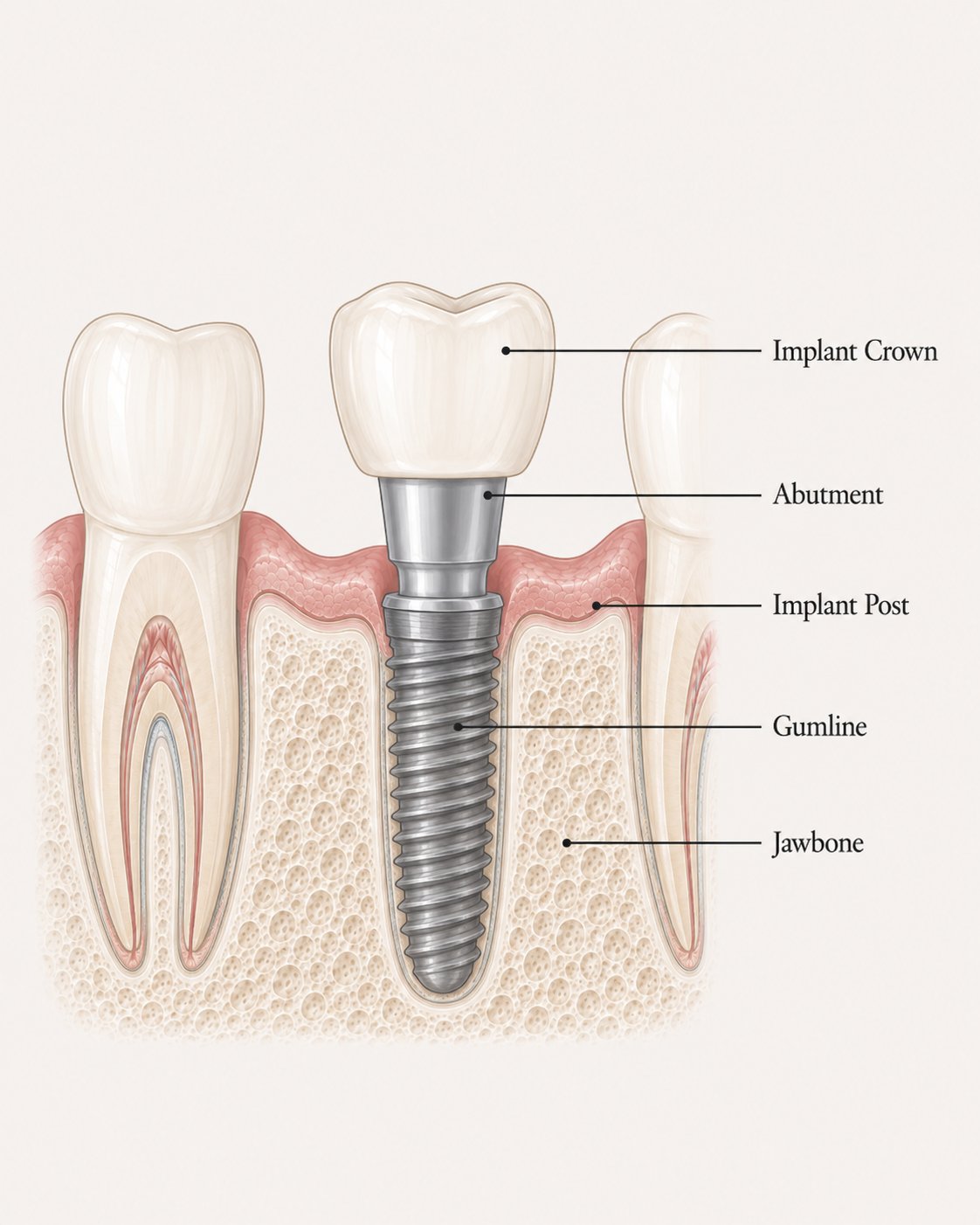
The reason implants work is a biological process called osseointegration. Titanium is one of the few materials the human body accepts without rejection — it's biocompatible. When a titanium implant post is placed in the jawbone, the bone cells grow directly onto and around the titanium surface over a period of 3 to 6 months, fusing the implant permanently to the bone.
This fusion is what makes an implant so stable. It doesn't slip, click, or shift the way a denture can. It transmits biting and chewing forces directly into the bone — just like a natural tooth root does — which also preserves the bone and prevents the shrinkage that occurs with other replacement options.
Who is a good candidate for implants
Implants are suitable for most healthy adults who are missing one or more teeth. The key requirements are:
- Sufficient bone volume — enough jaw bone to support and surround the implant post. If bone is insufficient, a bone graft can rebuild it first.
- Healthy gums — active gum disease must be treated before implant placement
- No uncontrolled medical conditions — certain conditions like uncontrolled diabetes can affect healing
- Non-smoker or willing to quit — smoking significantly increases implant failure rates
- Fully developed jaw — implants are not placed in teenagers whose jaws are still growing
The implant process — timeline
Getting a dental implant is not a single appointment — it's a process that takes several months from start to finish. The extended timeline exists because of the healing and osseointegration period.
- Consultation and planning. 3D imaging (CBCT scan) is taken to assess bone volume and plan implant placement precisely. Any needed bone grafting is discussed at this stage.
- Bone graft if needed. If bone volume is insufficient, a graft is placed first and allowed to heal for 3 to 6 months before implant placement.
- Implant placement surgery. Under local anesthesia (and sedation if preferred), the titanium post is placed into the jawbone. The gum is stitched over or around it.
- Osseointegration — 3 to 6 months. The implant fuses with the surrounding bone. You may have a temporary restoration during this period.
- Abutment placement. Once integration is confirmed, the abutment is attached to the implant post.
- Crown placement. An impression is taken, the custom crown is fabricated, and attached to the abutment. The implant restoration is complete.
Caring for implants
Implants are easy to care for — similar to natural teeth:
- Brush twice daily with a soft-bristled toothbrush
- Floss daily — including around the implant
- See your dentist for regular cleanings and checkups — the implant and surrounding tissue are checked at each visit
- Avoid very hard foods that could fracture the crown
How long do implants last?
Implants are designed to be permanent. With proper care, implant posts can last a lifetime. The crown portion typically lasts 15 to 25 years before needing replacement. Studies consistently show 95%+ success rates at 10 years.
The bottom line
A dental implant is the closest thing to a natural tooth that dentistry can offer. It's the only replacement option that preserves jawbone, requires no modification of adjacent teeth, and is designed to last a lifetime. For patients who qualify, it is almost always the best long-term investment for tooth replacement.
Read the full article
Create a free SmileSmart account to unlock every article instantly.