The phrase "root canal" is one of the most feared in dentistry — and one of the most misunderstood. Most people associate it with severe pain, but the truth is that a root canal is the treatment that relieves pain, not causes it. The discomfort you feel before the procedure is from the infection — the root canal is what fixes it.
This guide explains exactly what a root canal is, why your dentist recommends one, what happens step by step during the procedure, and what recovery looks like. By the end, you'll understand it clearly enough to walk into your appointment without fear.
The most important thing to know: Root canals are performed under local anesthesia. Most patients report that the procedure itself feels similar to getting a filling — pressure and vibration, but not pain.
Understanding your tooth's anatomy first
To understand why a root canal is needed, it helps to understand what's inside your tooth. A tooth isn't solid — it has layers, and at its center is living tissue.
Why a root canal becomes necessary
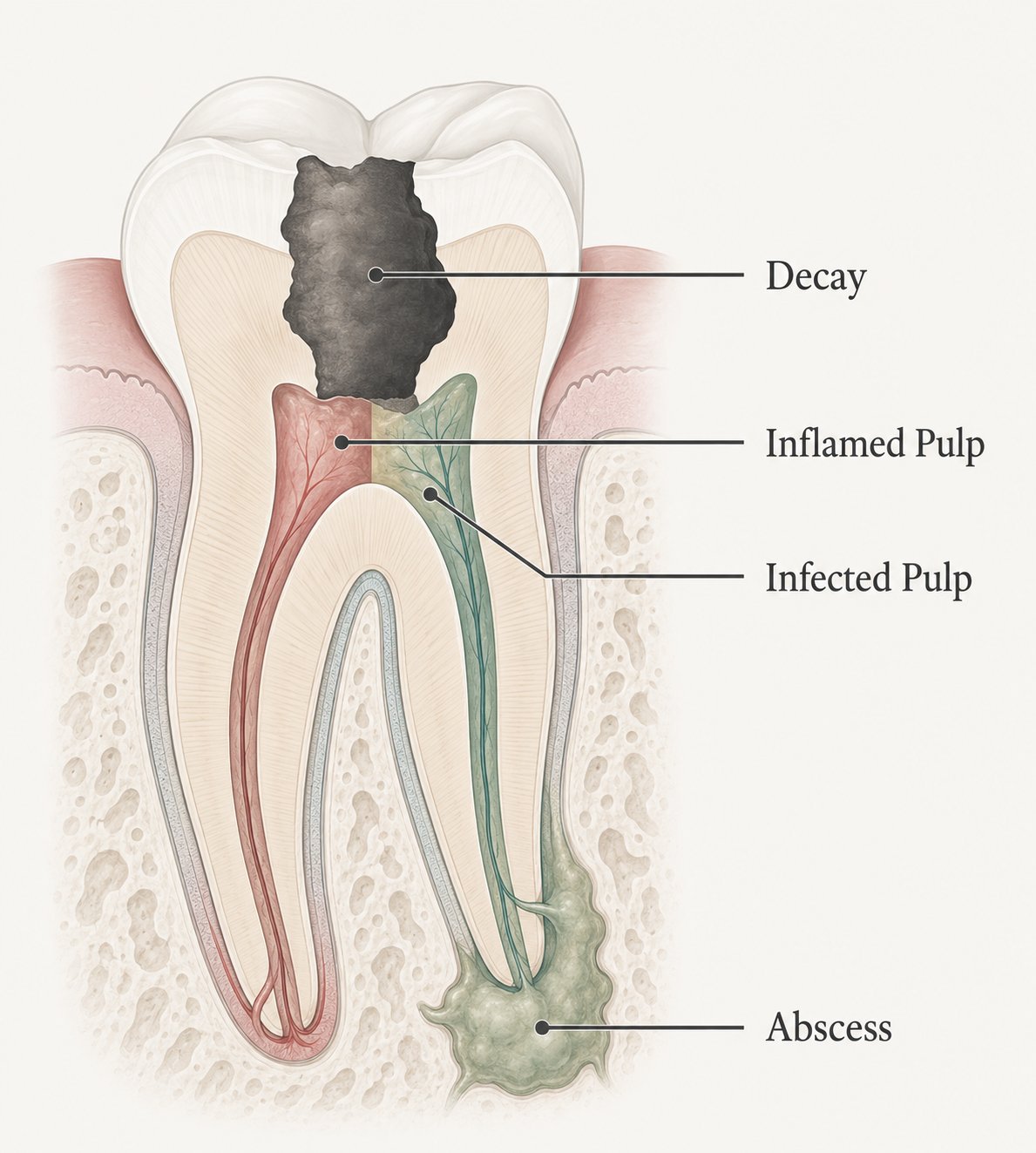
A root canal is needed when the pulp — the soft inner tissue of the tooth — becomes infected or severely inflamed. Once bacteria reach the pulp, the infection can spread down the roots, into the surrounding bone, and in serious cases, to other parts of the body.
The most common reasons this happens:
- Deep decay that wasn't treated early enough and reached the pulp
- A cracked or fractured tooth that allows bacteria to enter
- A large filling that has failed or allowed bacteria underneath
- Repeated dental procedures on the same tooth over time
- Trauma to the tooth — even without a visible crack, an injury can damage the pulp
Signs you may need a root canal
Severe toothache when biting or applying pressure. Prolonged sensitivity to hot or cold that lingers after the stimulus is removed. Darkening of the tooth. Swelling or tenderness in the nearby gums. A persistent pimple-like bump on the gums near the tooth. If you have any of these, see your dentist promptly — infections don't resolve on their own.
What is endodontics?
Endodontics (en-do-DON-tics) is the branch of dentistry that specializes in treating diseases of or injuries to the dental pulp. Endodontists are dentists who specialize in these diseases and injuries. If your case is complex, your general dentist may refer you to an endodontist to perform your root canal therapy. Either way, the procedure is the same — the specialist simply has additional training for more complicated cases.
What happens during a root canal — step by step
A root canal typically takes one to two appointments depending on the complexity of the case. Here's exactly what happens:
- X-rays and diagnosis. Your dentist takes X-rays to see the shape of the root canals and check for infection in the surrounding bone. This helps plan the procedure.
- Local anesthesia. The area around the tooth is numbed completely. You will feel pressure and movement during the procedure but should not feel pain. If you do, tell your dentist immediately — more anesthetic can be given.
- Tooth numbering for comfort. Before treatment begins, your dentist or endodontist will perform the necessary steps to ensure your comfort. The area is fully assessed and numbed before any instruments are used.
- Rubber dam placement. A thin, flexible sheet of latex or non-latex material is placed over your tooth and secured to keep the area dry and isolated. This protects the canals from bacteria in the mouth during treatment and improves visibility for the dentist.
- Access opening. The dentist drills a small opening through the crown of the tooth to access the pulp chamber and canals inside.
- Pulp removal. Using very thin files, the dentist removes the infected or inflamed pulp tissue from the chamber and canals. The canals are then shaped and cleaned with irrigating solutions to eliminate bacteria.
- Canal filling. Once cleaned and dried, the canals are filled with a rubber-like material called gutta-percha and sealed with dental cement to prevent future infection.
- Temporary or permanent restoration. The access opening is sealed. In most cases a crown is placed over the tooth afterward to protect and restore it fully.
Step 1–2
Anesthesia and isolation — you're comfortable before anything begins
Step 3–5
Pulp removed, canals cleaned thoroughly — the source of pain is eliminated
Step 6–7
Canals sealed and tooth restored — protected for the long term
Does it hurt?
This is the question everyone really wants answered. The honest answer is: the procedure itself, performed under proper anesthesia, should not be painful. Most patients are surprised by how manageable it is.
What you will feel during the procedure:
- Pressure and vibration from the instruments
- Occasional sharp sensation if an area wasn't fully numb — always tell your dentist so they can add more anesthetic
- A stretched or sore jaw from keeping your mouth open
After the procedure, as anesthesia wears off, you may experience:
- Mild to moderate soreness around the treated tooth for 2 to 4 days
- Sensitivity when biting that gradually improves
- Occasional tenderness in the gum tissue
Over-the-counter pain relievers like ibuprofen manage post-procedure discomfort effectively for most patients. Severe, worsening pain after a root canal is uncommon and should be reported to your dentist.
Recovery and what comes next
Most patients return to normal activity the day after a root canal. Here's what the recovery period looks like:
- First 24–48 hours: Avoid biting or chewing on the treated tooth until it is fully restored with a permanent crown. Make sure to continue brushing twice daily and cleaning the area to keep it free from infection. Eat soft foods. Take over-the-counter pain medication as needed.
- Days 3–7: Soreness decreases significantly. Most people are comfortable eating normally by this point.
- Crown placement: In most cases, a crown needs to be placed on the treated tooth within a few weeks. A tooth after a root canal is more brittle — the crown protects it from cracking under normal biting forces.
Important: Don't skip the crown. A root canal saves the tooth — but without a crown protecting it, the tooth is vulnerable to fracture. The crown is what makes the treatment last long-term.
How successful are root canals?
Root canal treatment has a high success rate — studies consistently show 85 to 97% of root canals remain functional after 8 years. When properly restored and maintained, a tooth with a root canal can last many years and even a lifetime. But like any other tooth, it can become decayed or fractured, or the tissue around it can get gum disease over time. Professional dental exams and regular cleanings are essential to help keep your mouth healthy and to monitor whether you have ever had root canal therapy or not.
In a small percentage of cases, retreatment may be needed if the tooth becomes re-infected or doesn't heal properly. An endodontist — a specialist in root canal treatment — handles complex or retreatment cases.
The bottom line
A root canal is not something to fear — it's the treatment that ends the pain you've been feeling. The procedure is performed under anesthesia, takes one to two appointments, and saves a tooth that would otherwise need to be extracted.
If your dentist has recommended a root canal, don't delay it. Infections don't wait, and the longer you wait, the more complex the treatment becomes.
Read the full article
Create a free SmileSmart account to unlock every article instantly.