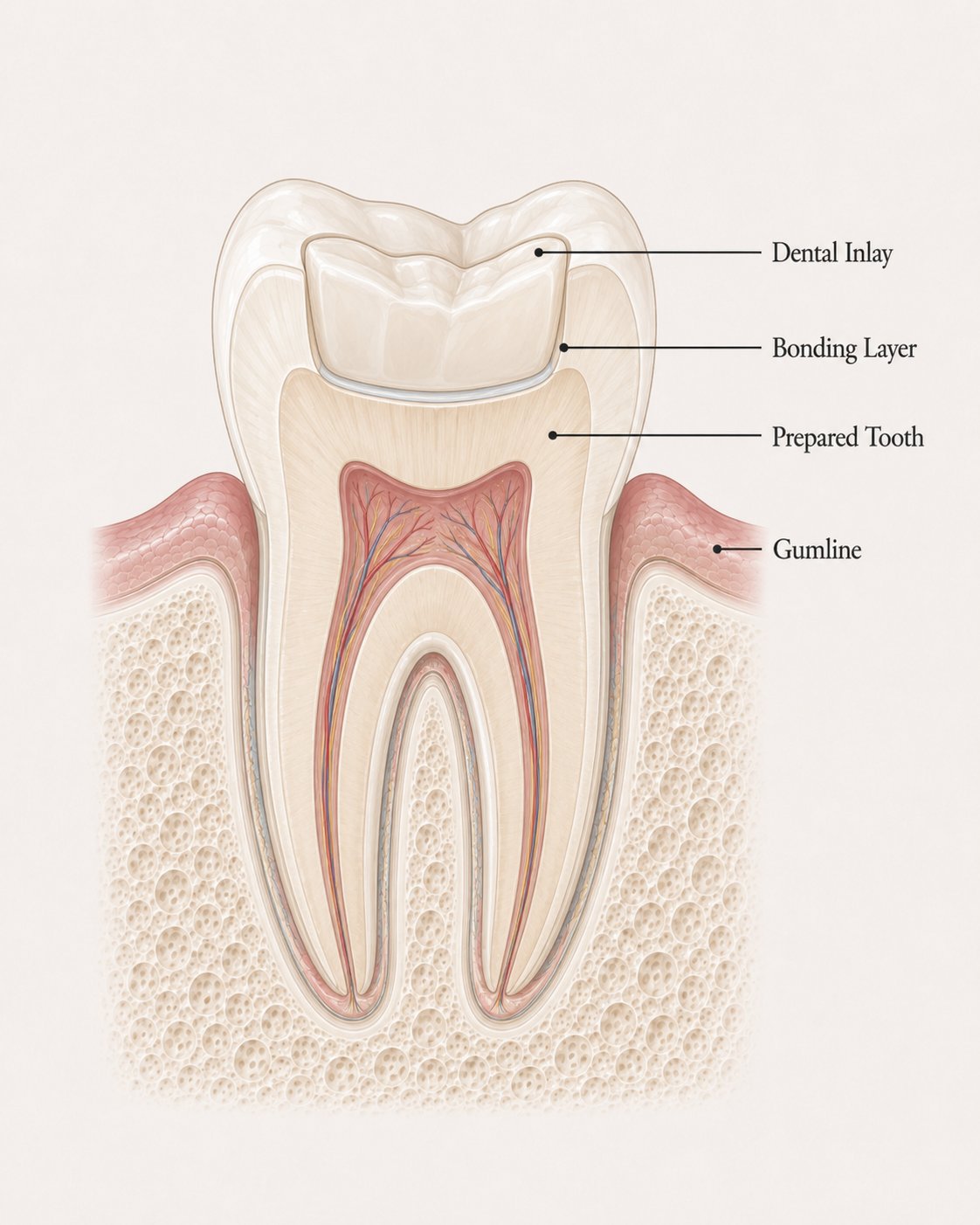
An inlay or onlay is a restoration that fills or covers a damaged area of a tooth — more extensive than a filling but less invasive than a full crown. They are custom-made in a dental lab and permanently bonded to the tooth for a precise, durable fit.
If your dentist has mentioned an inlay or onlay, it means the damage to your tooth is too large for a simple filling but doesn't require a full crown. This guide explains the difference, when each is used, and what the procedure involves.
Simple way to think about it: A filling is placed directly in the chair. An inlay or onlay is fabricated in a lab to fit your tooth exactly — like a custom puzzle piece. The result is stronger, more precise, and longer lasting than a filling for larger cavities.
Inlay vs Onlay — what's the difference?
Both are indirect restorations made outside the mouth in a dental lab and then bonded in place. The difference is in how much of the tooth they cover:
Filling
Placed directly in the tooth. Used for small to medium cavities. Done in one appointment.
Inlay
Fits within the cusps of the tooth. Used when the cavity is too large for a filling but doesn't extend over the cusps.
Onlay
Covers one or more cusps. Used when damage extends over the biting surface. Sometimes called a "partial crown."
Why inlays and onlays are recommended
- The cavity is too large for a filling to reliably restore without risk of the tooth cracking
- Old fillings that are failing need to be replaced with something more durable
- The cusp of the tooth is cracked or fractured and needs protection
- The tooth structure is weakened but intact enough that a full crown would remove more healthy tooth than necessary
What they're made of
- Porcelain/ceramic — tooth-colored, natural looking, ideal for visible teeth
- Gold — the most durable material, preferred by some dentists for back molars, very long lasting
- Composite resin — tooth-colored and less expensive, but less durable than porcelain or gold
What happens during the procedure
- Appointment 1 — Preparation. The tooth is numbed, the decay or old filling is removed, and the tooth is shaped. A digital scan or impression is taken and sent to the dental lab.
- Temporary restoration. A temporary filling protects the tooth while the lab fabricates your inlay or onlay — typically 1 to 2 weeks.
- Appointment 2 — Bonding. The temporary is removed, the inlay or onlay is checked for fit and color, and then permanently bonded to the tooth with dental cement.
Care and lifespan
Inlays and onlays are highly durable. Gold inlays can last 20 to 30 years. Porcelain typically lasts 10 to 15 years with proper care. Brush and floss normally, and see your dentist regularly for checkups.
The bottom line
Inlays and onlays are one of the most conservative and long-lasting restorations in dentistry. When a filling won't hold and a crown would remove too much healthy tooth, an inlay or onlay is the ideal middle ground.
Read the full article
Create a free SmileSmart account to unlock every article instantly.